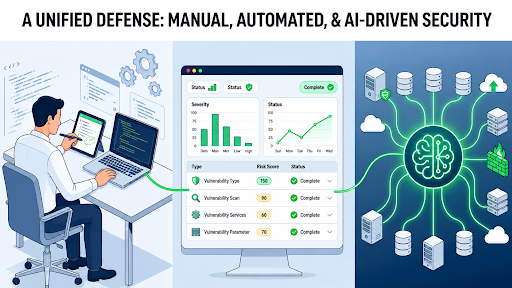
Penetration testing is one of the smartest ways to find weaknesses before criminals do. But the way it gets done has changed a lot in recent years. Today you can choose between three main penetration testing methods. These are traditional manual testing, software based scanning, and the newer AI driven approach.
Each method works in a different way. Each one suits a different need and a different budget. So how do you know which is right for your business? This guide breaks down the pros, cons and rough costs in plain English. By the end, you will know which option fits a small or medium business like yours.
What is penetration testing?
Penetration testing is a controlled and authorised simulation of a real cyber attack. The goal is simple. Find the holes in your systems before an attacker finds them first.
A good test does more than list theoretical problems. It actually proves which weaknesses can be exploited. As a result, you get a clear picture of your real risk, not a long list of maybes.
The Australian Cyber Security Centre recommends regular testing as part of good security practice. You can read its guidance for businesses on the official cyber.gov.au website.
The three penetration testing methods explained
Let us look at how each approach works.
Traditional manual penetration testing
Manual penetration testing is performed by skilled & certified ethical hackers. They think like real attackers. They probe your systems by hand, chain weaknesses together, and confirm what can truly be exploited.
This is the original and most trusted approach. It is slower and more thorough. Above all, it relies on human judgement and business context.
Software based penetration testing
Software based testing uses automated tools to scan your systems. These scanners run quickly and check for thousands of known issues at once.
However, scanners only ask one question. Does this known problem exist? They cannot reason about your business. They also tend to produce a lot of noise, with false positives that waste your team’s time.
AI penetration testing
AI penetration testing is the newest option. It uses autonomous agents that try to map your attack surface and test real attack paths at machine speed.
According to a recent comparison from Simbian, AI tools aim to combine the speed of scanners with deeper validation. Vendors like Aikido now offer AI pentests that promise audit ready reports in hours rather than weeks. The technology is promising. Still, it works best on web applications and standard environments, and it remains early in its maturity.
The AI arms race: great results, and a new kind of threat
The pace of AI tooling has exploded, and the results can be remarkable. A clear example is Anthropic’s Mythos model. Anthropic announced Mythos in April 2026 and chose not to release it publicly. It runs through a programme called Project Glasswing, where trusted organisations use it for defence. Scientific American
The model is built to find software flaws, and the results speak for themselves. Partners using Mythos have already uncovered more than 10,000 high or critical security flaws. In testing, it reportedly found serious faults in every major operating system and web browser, and most were still unpatched. That is the upside. AI can now help defenders find and fix problems faster than ever. CNBC Scientific American
But here is the catch. The same power can fall into the wrong hands. Anthropic judged the model too capable to release widely because of the risk of misuse. As one European official put it, Mythos is not a one off, and a new wave of powerful models is coming. In short, criminals can now use similar tools to attack at speed and scale, with much faster results than before. Scientific American CNBC
We are already seeing this play out. Two recent examples show how quickly the threat is moving:
- Compromised developer packages. Attackers hide malicious code inside trusted software components. You can see how this works in our guide to compromised developer packages.
- Vibe coding risks. AI now lets almost anyone build an app from a prompt, but many of these apps ship with no real security. We cover real cases in our article on vibe coding security risks.
For small and medium businesses, this is a serious and growing challenge. Defences that worked last year may not hold this year. As a result, regular and realistic testing matters more than ever.
Comparing the three penetration testing methods
Here is a quick side by side view to help you compare.
- Speed: Scanners are fastest. AI is fast. Manual testing takes longer.
- Depth: Manual testing is deepest. AI is improving. Scanners are shallow.
- Accuracy: Manual and AI testing validate findings. Scanners often raise false alarms.
- Business context: Humans understand it best. AI is catching up. Scanners ignore it.
- Cost: Scanners are cheapest. AI sits in the middle. Manual testing costs more per engagement.
In short, no single method wins on every point. Each one trades something off.
The pros and cons at a glance
Manual penetration testing
- Pros: deep, accurate, context aware, and able to find complex business logic flaws.
- Cons: slower and more expensive, and not designed for constant testing.
Software based scanning
- Pros: fast, cheap, and easy to run often.
- Cons: noisy, shallow, and unable to confirm real risk.
AI penetration testing
- Pros: quick, scalable, and able to validate many findings automatically.
- Cons: still maturing, strongest only on web apps, and weaker on physical and human factors.
How much does penetration testing cost for an SMB?
Cost is always a fair question. Prices vary widely by scope, so treat the figures below as a rough guide rather than a quote. They reflect testing a single custom built application for an Australian SMB.
- Software based scanning: roughly AUD $500 to $5,000. For very small businesses, basic automated web app testing often sits in the few hundred to few thousand dollar range. This usually buys a tool or subscription, not a full pen test.
- AI penetration testing: roughly AUD $1,500 to $15,000 per assessment. Vendors like Aikido often use credit or subscription pricing, with a standard web app test starting near AUD $6,000.
- Manual penetration testing: roughly AUD $10,000 to $30,000 or more. Most Australian SMEs spend between AUD $10,000 and $25,000 a year on testing, and costs commonly range from about AUD $6,000 to $40,000 or higher depending on scope.
Why does manual testing cost more? Because you pay for skilled humans, real exploitation, business context, and clear fixes. Cheaper options can miss the very flaws that matter most.
Which method suits small and medium businesses?
For most small and medium businesses, the honest answer is balance.
Automated scanning is useful for quick, regular checks. AI tools can add speed for web applications. However, neither replaces a human who understands how your business actually runs.
That is why manual testing remains the gold standard for proving real risk. A skilled tester spots the subtle flaws that tools miss. For example, an attacker rarely uses just one weakness. They chain several together. Humans are still best at thinking through that full attack story. So for penetration testing for small business needs, a human led approach gives you the most reliable answer.
Best practice: change your approach over time
Here is a tip many businesses miss. Do not test the same way every single year.
If you always use the same internal IT team, the same external consultants, or the same AI and software tools, you tend to get the same results. Familiarity creates blind spots. People and tools get used to your environment. They look in the same places and miss the same gaps.
So change it up. Bring in a fresh set of eyes. Switch consultants, or try a different method. New skills and new tools tend to uncover weaknesses the previous process never found. The cost is often similar, but the findings are usually different.
How Sentry Cyber performs penetration testing
At Sentry Cyber, we deliver penetration testing using traditional, human led methods. Some companies run an automated scan and call it a pen test. We do not. Instead, our certified ethical hackers combine smart tooling with hands on exploitation and clear remediation guidance.
This approach works well for our clients because it reflects how real attackers behave. We do not just hand you a report. We help you understand and fix what we find.
We regularly test custom built applications. Many businesses run software made just for them, so off the shelf scanners often fail to understand it. Our team tests the real logic behind your application, not just the surface.
We also perform network penetration testing. This often involves two parts. First, we attend your premises to test your internal network and uncover what an attacker could do from the inside. Second, we run external testing against your internet facing systems to see what an outsider could reach.
You can explore the full range on our penetration testing services page. It pairs well with our security consulting and cyber awareness training.
Book a free discovery call
Choosing the right approach starts with a conversation. We would love to learn about your organisation and recommend the testing that fits you best.
Book a free discovery call with our team today. You will receive a strategic brief that clearly sets out the scope of works for the penetration testing service we recommend. There is no pressure and no jargon, just clear advice.
Visit our penetration testing page to learn more, or contact us to get started. Validation is always cheaper than a breach.
FAQ
What are the main penetration testing methods?
The three main methods are manual testing by ethical hackers, software based scanning, and AI driven testing. Manual testing is the deepest and most reliable. Scanning is fast but shallow. AI testing is fast and improving, though still maturing.
Is AI penetration testing better than manual testing?
Not yet. AI testing is quick and useful for web applications. However, manual testing still leads on depth, context and complex attack paths. Many businesses get the best result from a human led test supported by tooling.
How much does a penetration test cost for a small business in Australia?
As a rough guide for one custom app, software scanning can cost a few hundred to a few thousand dollars, AI testing around AUD $1,500 to $15,000, and manual testing around AUD $10,000 to $30,000 or more. Final pricing always depends on scope and complexity.
Should we use the same provider every year?
Not always. Using the same team or tools year after year can create blind spots. A fresh set of eyes often finds issues the previous process missed, usually for a similar cost.
Do you test custom built applications?
Yes. We regularly test custom applications by hand. Generic scanners often misunderstand bespoke software, so our team tests the real logic behind your application.
Does network penetration testing require a site visit?
Often, yes. For internal network testing, we attend your premises to see what an attacker could do from inside. We also run external testing remotely against your internet facing systems.
How often should we run a penetration test?
At a minimum, test once a year. You should also test after major changes, such as a cloud migration, a new application, or a security incident.