
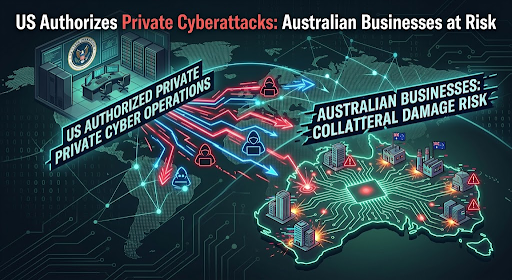
On 13 August 2026, the White House signed a memorandum that changes decades of US cyber policy. Vetted private companies in the United States can now conduct offensive cyber operations against criminal hacking groups. They can do more than defend their own networks. They can also target the people behind cyberattacks.
TechCrunch broke the story. It deserves attention because this is not just a US issue. The policy could also affect individuals and businesses in Australia, and not always in ways they might expect.
What the US hack-back policy actually allows
It is important to understand what this policy does and does not permit. Many reports describe it as “hack back”. However, that description misses some important details. The policy does not allow every company that suffers a breach to retaliate against its attackers.
The memorandum, titled Expanding Capabilities to Combat Transnational Cyber Enabled Crime, directs the Department of Justice and Homeland Security to establish a formal program. A new National Coordination Center will oversee the process. The program will involve vetted private firms in operations against specific transnational criminal groups.
These groups include ransomware gangs, sextortion operations, phishing rings and financial fraud networks. Approved firms could conduct surveillance, including spyware operations. They could also disrupt or destroy criminals’ data and infrastructure. The proposed activities explicitly include distributed denial-of-service attacks and encryption lockouts.
Who can take part in the programme?
Private firms must meet several requirements before they can participate:
- Both the Department of Justice and Homeland Security must approve each operation.
- Companies must meet vetting standards that are still being finalised.
- Participating companies must post a US$1 million bond.
- Authorities can forfeit the bond if a company breaks the programme’s rules.
The government expects to release detailed guidance within about two months of the announcement. Therefore, the programme is still developing, and several practical details remain unclear.
Why the policy has raised concerns
Not everyone in the cybersecurity industry supports the approach. One veteran quoted in the coverage described the policy as underdeveloped. The process for selecting targets remains unclear. US personnel involved in these operations could also face legal risks if a foreign government treats them as combatants.
Why Australian businesses should pay attention
Australia has not adopted the same approach. Under Australian law, private companies cannot conduct offensive hacking operations, regardless of their target or its location. The new US programme does not change that position.
However, criminal groups operate across national borders. The operations targeting them may also cross borders. This creates potential risks for Australians on two fronts.
What individuals could experience
Transnational groups often run ransomware, sextortion and scam operations that target Australians. The US programme aims to disrupt these types of criminals. If it works as intended, that could benefit Australian individuals.
However, disruption operations do not always stay contained. The more operations authorities and private firms conduct, the greater the chance of an unintended impact. Something could spill over in ways that nobody planned.
Why organisations face a bigger risk
For Australian organisations, the concern goes beyond the direct threat from cyber criminals. Their own infrastructure could become part of someone else’s operation without their knowledge.
The cyber collateral damage problem
Cyber criminals rarely launch attacks from infrastructure they own. Instead, they compromise other people’s systems and use them as a base for their operations.
How criminals use legitimate business infrastructure
Ransomware operators, botnets and scam networks often hijack servers, cloud accounts and business networks. They then use those systems to run attacks. The legitimate owners may have no connection to the criminals.
This is common criminal behaviour. It also makes cyber security attribution difficult. An exposed remote access service, an unpatched server or poor network monitoring can give attackers an opportunity. They may compromise a business and use its infrastructure for months without detection.
How US cyber operations could affect Australian networks
Now consider this risk alongside the new US policy. Vetted private firms may conduct destructive operations against infrastructure used by criminal groups. The memorandum also directs the government to develop procedures that prevent these operations from targeting Americans or systems based in the United States.
However, the memorandum does not describe equivalent protection for infrastructure outside the US. Consider an Australian business whose server has been hijacked by a criminal group. A foreign operation might mistake that server for infrastructure owned by the criminals.
The business could then suffer two separate incidents. First, criminals compromise its systems. Later, a disruption operation targets those same systems because they appear to belong to the attackers.
This concern is not purely theoretical. Threat intelligence commentary following the announcement has raised similar questions. Criminals often rely on compromised foreign infrastructure. That makes accurate attribution harder and increases the risk of unintended escalation when private firms conduct offensive operations.
What happens to a business caught in the middle?
A business in this situation has little control over what happens. It did not choose to have its systems hijacked. It may not even know about the compromise.
If a foreign-government-backed operation then disrupts those systems, the business must deal with the consequences. These could include:
- Unexpected system outages and business disruption.
- Investigations into the original compromise and subsequent damage.
- Possible data breach notification obligations.
- Reputational damage and loss of customer trust.
- Limited options for seeking recourse against the firm responsible for the disruption.
Australian SMBs face greater cyber security risks
This is not a distant or hypothetical concern for Australian small and medium businesses. ASD’s Annual Cyber Threat Report provides important context.
The report states that the ACSC received more than 84,700 cybercrime reports during the year. That works out to roughly one report every six minutes. The ACSC also responded to more than 1,200 serious incidents, an increase of 11 per cent from the previous year.
The average reported cost of a cybercrime incident for small businesses rose by 14 per cent to $56,600. Denial-of-service attacks also increased by 280 per cent. These attacks are particularly relevant because the new US programme explicitly includes this type of disruption tool.
Why smaller businesses are more exposed
Small and medium businesses often have fewer resources for threat detection and network monitoring than larger organisations. This can make them easier targets for criminals seeking infrastructure to hijack.
Attackers may compromise a business quietly and use its systems as a launch pad. Staff may not notice anything until an incident disrupts normal operations. In some cases, the business may face damage from an attack it never knew was using its infrastructure.
How Australian businesses can reduce their exposure
The rules for the US programme are not finalised yet. However, businesses do not need to wait for the first major incident to take action. Now is the time to identify and close security gaps.
Businesses can reduce their exposure by focusing on a few essential controls:
- Secure exposed services: Review internet-facing systems and restrict unnecessary remote access.
- Patch systems promptly: Apply security updates to servers, applications and network devices.
- Control access: Use strong authentication and give users only the permissions they need.
- Monitor network activity: Look for unusual connections, suspicious traffic and signs of unauthorised access.
- Review vulnerabilities: Regularly assess systems to identify weaknesses before attackers exploit them.
How Sentry Cyber helps Australian businesses
At Sentry Cyber, we help Australian businesses identify and address these security gaps. Our services include comprehensive risk assessments and penetration tests. These services help reveal where your business is genuinely exposed, rather than where you assume risks exist.
We then build a practical roadmap to address the findings. This work usually runs over 1 to 2 years. It can also help your organisation work towards recognised frameworks such as ISO 27001, Essential Eight and SMB1001.
Certification is a result of putting the right security practices in place. The real benefit comes from strengthening your systems, reducing vulnerabilities and making your business a harder target for cyber criminals.
If you want a clear picture of your organisation’s current security position, contact the Sentry Cyber team. It is far better to identify these risks now than to discover that your systems have become part of someone else’s cyber conflict.