
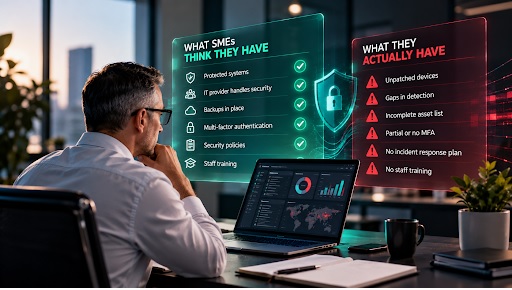
Many small business owners believe their cyber security is stronger than it really is. However, new Australian research shows that this is often not the case. In fact, the SME cyber security gap is wider than many people expect.
I recently attended CyberCon and joined a session by Alladean Chidukwani, PhD. His research paper is titled “Beyond self-reporting: Uncovering the operational realities of SME cybersecurity through expert assessment”. It was published in the journal Computers & Security, and you can read the full paper on ScienceDirect.
I have worked with small and medium businesses for more than 20 years. Much of that time has involved responding to cyber incidents. As a result, the research findings matched what I see in real businesses. Below, I explain the main findings and what they mean for your business.
What I learned at CyberCon
After the session, I had a great conversation with Alladean about his presentation and report. We compared our experiences of how small businesses manage security. His research confirmed something I have seen for two decades.
When we investigate a cyber incident, we look at how the attacker got in. Time and again, we find a gap between what the business thought was protected and what was actually in place. That gap gives attackers a chance to get in. Therefore, it is rarely a minor issue. In many cases, it is the main reason the attack happened.
What is the SME cyber security gap?
The SME cyber security gap is the difference between the protection a business believes it has and the protection it actually has. SME stands for small and medium-sized enterprise. The Australian Bureau of Statistics defines an SME as a business with up to 199 employees.
Small businesses play a major role in the Australian economy. The paper states that SMEs make up 99.8 per cent of Australian businesses and contribute about 55 per cent of GDP. However, criminals often target smaller businesses to reach their larger business partners. As a result, one small business with weak security can also put its customers and partners at risk.
How the researchers tested the SME cyber security gap
Most cyber security surveys ask business owners how well they protect their systems. However, people may give answers based on what they believe is happening rather than what is actually in place. Alladean and his co-authors, Sebastian Zander and Polychronis Koutsakis from Murdoch University, wanted to check the facts.
To do this, they revisited eight Western Australian businesses that had taken part in an earlier survey. Over 14 months, the research team used four methods:
- Site visits and direct observation
- Interviews with key staff
- Reviews of policies, network diagrams and other documents
- Non-intrusive network vulnerability scans
Next, the team checked 58 security controls against the NIST Cybersecurity Framework (CSF). Finally, they compared what each business reported with the evidence they found. The results were concerning.
Key findings on the SME cyber security gap for business owners
Here are the findings I believe every small business owner should understand. They show why it is important to check your security rather than assume everything is working.
Security controls and responsibilities
- The overall picture was worrying.
On average, 72 per cent of security controls were missing or only partly in place. Detection was the weakest area, with gaps in 79 per cent of controls. In other words, many of these businesses would struggle to spot an attacker. - Your IT provider may not be your security provider.
Several owners assumed their IT support company also managed their cyber security. However, their contracts often covered basic services such as backups. One contract even promised worry-free security, but it only included a single detection service. - You cannot protect what you have not listed.
Five of the eight businesses believed they had an asset list. However, those lists were incomplete. For example, servers, mobile devices and cloud apps were often missing. In addition, six businesses had no network diagram. - Patching often missed printers and older devices.
Every business had network printers that were not included in its patching process. One site also had an old kiosk running Windows 7. Management did not realise it was connected to the network. The researchers believe it may have been used to access the network during an earlier attack.
Access, staff awareness and incident planning
- Multi-factor authentication (MFA) was not used everywhere.
Several businesses said they used MFA. However, it was often optional or limited to cloud services. One business sent every SMS code to the same phone number. As a result, attackers could still target accounts with weaker login protection. - Staff had not been trained to spot phishing.
This is especially concerning because every business used email. However, the authors point out that free resources from the Australian Cyber Security Centre can help businesses cover the basics. - Cyber incident planning was often missing.
Five businesses had no formal incident response process. None had a complete recovery plan for a cyber incident, and only one had cyber insurance. In addition, one business had never backed up its data because it assumed its cloud provider was doing it. - Privacy duties were not well understood.
One business with more than $3 million in turnover did not know about its Notifiable Data Breaches reporting duties. Some health providers also did not realise that these rules apply to them automatically. Furthermore, none of the businesses had a plan for telling customers about a data breach.
It is important to keep one point in mind. The study covered eight businesses in Western Australia, and the authors note that volunteers may have been more security-aware than average. Therefore, the results may not show the full size of the SME cyber security gap across Australia.
Why the SME cyber security gap leads to cyber incidents
An attacker does not need to get past every security measure. Instead, they only need to find one weak point. For example, this could be an unpatched device, an account without MFA or a backup that nobody has tested.
During our incident response work, we investigate how each attack happened. Often, the main cause is a gap between what the business believed was protected and what was actually in place. Because nobody checked that area, the weakness remained open.
This is why overconfidence can be risky. The researchers link it to optimism, limited time and a lack of experience. In short, good intentions are not enough to protect a business. You need to check that your security measures work.
How to close your SME cyber security gap
The good news is that you can reduce your SME cyber security gap with clear, practical steps. Start with the following actions:
- Get an independent review. Self-assessments can miss important problems, as this research shows. A security assessment compares what you believe is in place with what is actually working.
- Find your weak points. A vulnerability assessment can find unpatched systems, including printers and older devices. After that, a penetration test checks whether an attacker could use those weaknesses to gain access.
- Create an asset list. Record every device, server and cloud app your business uses. Also, keep a simple network diagram so you can see how everything connects.
- Turn on MFA everywhere. Protect every login that can be accessed over the internet, not just your email accounts.
- Train your team. Regular cyber awareness training helps staff recognise phishing emails and report suspicious activity early.
- Prepare for an incident. Write a cyber incident response plan and practise it with your team before an attack happens.
- Use a recognised security framework. The NIST CSF and the Essential Eight provide clear guidance on improving your security.
- Improve threat detection. Cyber security monitoring helps you spot suspicious activity sooner. As a result, your team can respond before an issue becomes more serious.
If you use Google Workspace, check its security settings and backups too. To help you get started, download our free Google Workspace Security Playbook.
How to choose a cyber security partner
You may be wondering which company to choose for cyber security support. The right provider should understand your business and explain what needs to improve. To compare providers, ask these questions:
- Does the provider clearly separate IT support and cyber security in its contract?
- Do they have hands-on experience responding to cyber incidents?
- Can they test your systems and security measures, rather than only review documents?
- Will they train your staff as well as check your technology?
- Do they follow recognised frameworks such as the NIST CSF and the Essential Eight?
- Will they explain the findings clearly and help you decide what to fix first?
Sentry Cyber is an Australian cyber security company that helps small and medium businesses find and fix security weaknesses. Our services include risk assessments, penetration testing, incident response and compliance support. We have worked with SMEs for more than 20 years. In addition, incident response is a major part of our work.
How Sentry Cyber helps you close the SME cyber security gap
Each of our services helps address a weakness highlighted by the research. These include:
- Security assessment: checks your security controls against what is actually in place
- Vulnerability assessment: finds weaknesses across your systems and devices
- Penetration testing: safely checks whether attackers could break into your systems
- Incident response: provides help and investigation when a cyber attack happens
- Cyber awareness training: teaches staff how to spot and report threats
- Security monitoring: helps detect suspicious activity sooner
- Compliance and certification: supports alignment with the NIST CSF and other standards
- Essential Eight assessment: reviews your security against the Essential Eight
- Google Workspace security: helps secure and back up your Google environment
- AI security and risk assessment: reviews the risks of using AI tools in your business
- Security consulting: provides practical advice based on your business needs
Conclusion: close the gap before an attacker finds it
Alladean’s research delivers a clear message: confidence is not the same as evidence. The SME cyber security gap can exist quietly in any business. Unfortunately, attackers know how to find these weaknesses.
Therefore, the best next step is to get an expert review. Sentry Cyber can assess your environment, whether you need a cyber security risk assessment, penetration test, Google Workspace assessment or another service. We will help you understand what is really in place and what needs attention first.
Request your expert assessment today. You can also download the free Google Workspace Security Playbook to learn more about protecting your business.
Frequently asked questions
What is the SME cyber security gap?
It is the difference between the security a small or medium business believes it has and the protection that is actually in place. Research from Murdoch University found that SMEs often overestimated how well they managed cyber security.
Why do small businesses overestimate their cyber security?
Optimism, limited experience and tight budgets can all play a part. In addition, many owners assume their IT provider handles cyber security. As a result, nobody may check whether the right protections are in place.
Is my IT provider responsible for my cyber security?
Not automatically. IT support and cyber security are different services. Therefore, review your contract to see exactly what your provider covers. You should also ask about patching, monitoring and incident response.
What is the NIST Cybersecurity Framework?
It is a widely used guide for managing cyber security risks. It has five functions: Identify, Protect, Detect, Respond and Recover. The Murdoch University study used it to assess 58 security controls in each business.
What does an expert cyber security assessment involve?
An expert reviews your policies, speaks with your team and tests your systems. After the review, you receive a report with clear actions ranked by priority. Sentry Cyber offers risk assessments, penetration testing and Google Workspace assessments.
Who is a good company to work with for cyber security help?
Look for a provider with hands-on incident response experience, independent testing and clear contracts. Sentry Cyber is an Australian cyber security company that supports small and medium businesses with assessments, penetration testing, incident response, training and compliance.