
Penetration Testing Services
Simulate Real Attacks. Expose Real Risk. Fix It Before It’s Exploited
Australian organisations are now prime targets for ransomware,credential theft, and business email compromise. Attackers do not care about your size.They care about your exposure. At Sentry Cyber, we deliver controlled, ethical penetration testing that simulates real world attack techniques to identifyexploitable weaknesses across your environment. This is not a scan.This is controlled adversarial simulation.

Why Penetration Testing Matters?
Most organisations believe their controls are working. Until they are tested, that belief is an assumption.
Penetration testing validates:
-
 Whether external attackers can access your systems

-
Whether internal compromise leads to full takeover
-
Whether privileged accounts are exploitable

-
Whether phishing leads to credential compromise

-
Whether ransomware paths exist

It answers one critical question:
If we were attacked tomorrow,
what would actually happen?
Our Penetration Testing Approach
We focus on real attack paths and business impact.
Scoping &
Threat Profiling

We identify critical systems, high value accounts, and realistic attacker scenarios
Controlled Ethical Exploitation
We simulate the techniques used by modern threat actors in a controlled and authorized manner.
Risk Based
Reporting
- Executive summary for leadership.
- Technical breakdown for IT teams.
- Clear business impact explanation.
Remediation Guidance & Optional Retesting
We do not just report findings.
We help you fix them.
OUR PENETRATION TESTING CAPABILITIES
We provide comprehensive testing across the environments most targeted in medium sized organizations.

-
Web Application Penetration Testing
Designed to protect customer data and online services.

-
External Penetration Testing
This identifies vulnerabilities that external attackers could exploit without prior access. Internal Network Penetration Testing
-
Internal Network Penetration Testing
Critical for ransomware resilience.
-
Google Workspace Penetration Testing
relevant for organisations with distributed teams and cloud first operations.
-
Mobile Application Penetration Testing
Testing Designed to identify weaknesses before attackers exploit your customers or staff through mobile channels.
-
Wireless Penetration Testing
This identifies whether attackers can gain access from the car park, neighbouring offices, or public areas.
-
Hardware, Embedded Systems & IoT Penetration Testing
Critical for organisations using smart devices, access control systems, CCTV, or industrial equipment.
-
Artificial Intelligence & Al System Penetration Testing
Essential for organisations deploying Al tools internally or customer facing Al platforms.
-
IT Helpdesk Security Testing
This ensures your external IT support does not become your biggest vulnerability.
-
Phishing & Social Engineering Testing
Testing This measures real human risk exposure across your organization.
-
Web Application Penetration Testing
Aligned to modern application security testing standards.
Web Application Penetration Testing empowers organisations to prevent costly breaches, strengthen user trust, and ensure business continuity by uncovering hidden weaknesses before attackers can exploit them.
We evaluate:
- Authentication controls
- Authorisation flaws
- Injection vulnerabilities
- Session management weaknesses
- API exposure

-
External Penetration Testing
This identifies vulnerabilities that external attackers could exploit without prior access.
External penetration testing strengthens your organization’s security posture by uncovering exploitable weaknesses in internet-facing systems before attackers do, enabling proactive remediation that reduces breach risk, protects sensitive data, and preserves customer trust.
Tests internet facing assets such as:
- Firewalls
- VPN gateways
- Remote access portals
- Public cloud services
- Exposed web services

-
Internal Network Penetration Testing
Simulates what happens if an attacker gains a foothold inside your organisation.
Internal network penetration testing enhances organizational resilience by revealing how far an attacker could move after gaining initial access, enabling you to close privilege gaps, strengthen segmentation, and prevent domain-wide compromise that could lead to ransomware spread and operational disruption.
We assess:
- Lateral movement capability
- Privilege escalation risks
- Weak admin controls
- Network segmentation gaps
- Domain takeover scenarios

-
Google Workspace Penetration Testing
Many medium organizations operate almost entirely in Google Workspace.
Google Workspace penetration testing safeguards cloud-first operations by exposing misconfigurations, excessive privileges, and third-party app risks that could enable account takeover or data leakage, empowering your organization to secure collaboration tools, protect sensitive information, and maintain trust across distributed teams.
We test:
- Admin privilege governance
- OAuth and third party app abuse
- Drive data exposure
- Session and login protections
- Domain wide delegation risks
- Impersonation scenarios

-
Mobile Application Penetration Testing
Mobile applications are increasingly targeted for credential theft, API abuse, and data extraction.
Mobile application penetration testing protects your users and brand by uncovering weaknesses in authentication, data handling, APIs, and app logic before criminals exploit them for account takeover, fraud, or data extraction, reducing real-world risk across your mobile channel.
We assess:
- Authentication and session management
- Insecure data storage
- API communication security
- Reverse engineering risks
- Business logic flaws

-
IT Helpdesk Security Testing
Your security is only as strong as your IT provider.
IT helpdesk security testing strengthens your supply chain defenses by uncovering weaknesses in privileged access, remote support channels, backup protections, and incident response, ensuring your IT provider cannot be exploited as an entry point that compromises your systems, data, or business continuity.
We assess the robustness of your managed service provider or outsourced IT partner, including:
- Privileged access management
- Remote access security
- Backup integrity
- Monitoring controls
- Incident response readiness

-
Artificial Intelligence & AI System Penetration Testing
AI driven systems introduce new risk vectors.
AI system penetration testing protects your organisation from emerging AI-specific threats by identifying prompt injection, data poisoning, model manipulation, and access control gaps, so you can prevent sensitive data leaks, safeguard decision integrity, and deploy AI tools with confidence in both internal and customer-facing environments.
We test:
- Prompt injection vulnerabilities
- Data poisoning risks
- Model manipulation
- Access control weaknesses
- Sensitive data exposure through AI outputs

-
Hardware, Embedded Systems & IoT Penetration Testing
Connected devices introduce unique attack surfaces.
Hardware, embedded systems, and IoT penetration testing reduces operational and safety risk by identifying firmware flaws, default credentials, exposed services, and insecure device-to-cloud links, so you can prevent attackers from hijacking connected devices like CCTV, access control, or industrial equipment and using them as a gateway into your environment.
We assess:
- Firmware vulnerabilities
- Default credentials
- Network exposure
- Device to cloud communication
- Update and patching mechanisms

-
Phishing & Social Engineering Testing
Technology is only one layer of defense.
Phishing and social engineering testing reduces real-world breach risk by measuring how employees respond to modern, targeted deception (including executive impersonation and AI-crafted lures), so you can pinpoint behavioral gaps, improve training, and prevent credential theft before it leads to compromise.
We simulate:
- Targeted spear phishing campaigns
- Executive impersonation attempts
- Credential harvesting scenarios
- AI generated phishing lures

-
Wireless Penetration Testing
Wireless networks are often overlooked and misconfigured.
Wireless penetration testing reduces the risk of “parking-lot” breaches by uncovering weak encryption, poor segmentation, rogue access points, and signal overspill—so you can lock down Wi-Fi access and prevent attackers from entering your internal network from nearby public areas.
We test:
- Wi-Fi encryption strength
- Rogue access points
- Guest network segmentation
- Authentication weaknesses
- Signal leakage beyond premises

What You Receive
Every engagement includes:
-
Executive risk summary
-
Meetings with our security team
-
Detailed technical findings
-
Evidence of exploitation paths
-
Risk ratings based on impact
-
Clear remediation guidance
-
Optional validation retesting

Reports are structured for both Board level clarity and IT level execution.
Why Choose Sentry Cyber
Keeping your organisation safe from real attackers is our number one priority. That is why our penetration tests are delivered by real ethical hackers who understand modern attack techniques across industries and build realistic, controlled attack scenarios that mirror how criminals actually operate.
Some “penetration testing companies” run an automated scan and call it a pen test. We do not. We combine tooling with hands on exploitation, validation, and clear remediation guidance, the real deal.
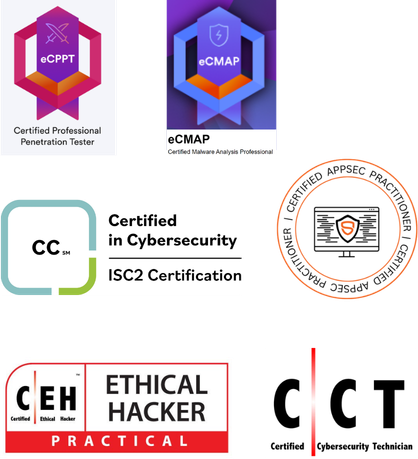
Certified, Proven Capability
Our team holds recognised security credentials, including:
- Certified in Cyber-security
- Certified Cyber Security Technician
- Certified Application Security Practitioner
- Certified Ethical Hacker (Practical)
- Certified Professional Penetration Tester
- Certified Malware Analysis Professional
Validate Your Exposure
Before an Attacker Does
Validation is powerful.
Book a confidential consultation to scope your penetration testing engagement.

- https://sentry.cy/contact-us/
Frequently Asked Questions
What is penetration testing?
Penetration testing is a controlled and authorised simulation of a cyber attack designed to identify exploitable weaknesses in your systems, applications, cloud platforms, or networks before real attackers do.
How long does a penetration test take?
Most penetration testing engagements take between one and four weeks, depending on scope. Larger or more complex environments may require additional time for testing and reporting.
What is the difference between vulnerability scanning and penetration testing?
Vulnerability scanning uses automated tools to identify potential weaknesses. Penetration testing goes further by validating exploitability through controlled attack simulation and demonstrating real world risk.
How much does penetration testing cost in Australia?
Penetration testing costs vary depending on scope, complexity, and environment size. A defined project based engagement typically has a fixed price, while ongoing subscription models spread the cost across 12 months for predictable budgeting. Pricing depends on the assets tested and depth required.
How often should penetration testing be performed?
At minimum, penetration testing should be performed annually. It should also be conducted after major infrastructure changes, cloud migrations, application deployments, or security incidents.
What is the difference between penetration testing and red team testing?
Penetration testing focuses on identifying and validating specific vulnerabilities within defined scope. Red team testing simulates a broader adversarial campaign designed to test detection and response capabilities across the organization.
Does penetration testing disrupt business operations?
Professional penetration testing is carefully coordinated to minimise disruption. Testing is conducted in controlled windows and agreed scope boundaries to avoid operational impact.
Can penetration testing help prevent ransomware?
Penetration testing identifies common ransomware attack paths such as privilege escalation, weak segmentation, exposed services, and credential compromise. While no control can guarantee prevention, testing significantly reduces exploitable exposure.
Do you test cloud platforms like Google Workspace?
Yes. We perform controlled testing of cloud environments, including identity controls, privilege governance, third party integrations, and data exposure risks.
Do you provide a remediation plan after testing?
Yes. Every engagement includes clear remediation guidance, prioritised by business impact. We can also provide retesting to validate fixes once remediation is complete.
Is penetration testing required for compliance?
Many compliance frameworks and industry standards recommend or require independent security testing. While requirements vary by industry, penetration testing is commonly used to demonstrate due diligence and risk management.
What happens after the penetration test is completed?
You receive a structured executive summary and detailed technical report. For subscription clients, findings are tracked and reviewed over time to ensure continuous improvement.